

Ecoeficiência Program
Copel launched the Eco-Efficiency Program in 2014 with the goal of strengthening sustainability in its operations and encouraging the responsible use of natural resources. In addition to its activities in power generation, transmission, and distribution, the Company plays a strategic role in promoting practices that contribute to environmental preservation.
To this end, it implements initiatives aimed at reducing the consumption of energy, water, fuel, and paper, in addition to adopting appropriate waste management practices. In this way, it aligns operational efficiency with the principles of sustainability.
The Eco-Efficiency Program brings together initiatives that promote the conservation of natural resources, contribute to people’s quality of life, and respect the planet’s carrying capacity.
By implementing these actions, Copel reinforces its commitment to sustainability and demonstrates its environmental responsibility. At the same time, it invests in raising employee awareness to encourage the efficient use of natural resources and strengthen an organizational culture focused on sustainability. As a result, these initiatives contribute to environmental preservation, process optimization, cost reduction, and the promotion of environmental education, always with a focus on future generations.
Water
According to the United Nations Educational, Scientific, and Cultural Organization (UNESCO), global water consumption has increased by approximately 1% per year over the past 40 years, with more significant growth in less developed countries. Furthermore, projections indicate that global demand will continue to rise at a rate of about 1% per year, potentially reaching between 20% and 30% by 2050.
In light of this scenario, Copel is stepping up efforts to preserve and use this essential resource for life in a responsible manner. Among the key initiatives are the installation of cisterns to collect and reuse rainwater at some facilities, the gradual replacement of conventional faucets with timed models, and the continuous monitoring of water consumption in administrative buildings.
In addition, the Company conducts monthly water performance analyses to identify opportunities for improvement, increase water use efficiency, and strengthen the sustainable management of natural resources.
Source: UNESCO.
Energy
Copel understands energy and continually seeks to raise awareness about its efficient use. For this reason, it develops initiatives that demonstrate how it is possible to consume energy responsibly, reducing waste and optimizing resources.
In this context, the Eco-efficiency Program establishes goals and initiatives aimed at reducing energy consumption at the Company’s facilities. Notable among the initiatives implemented are the reduction in the operating time of air conditioning systems at the company’s largest facility in Curitiba; the installation of energy management modules in computer equipment; and the gradual replacement of conventional light bulbs with LED technology, as maintenance needs arise.
In addition, Copel promotes awareness campaigns targeting both internal and external audiences, encouraging more sustainable and efficient consumption habits.
To complement these initiatives, the Energy Management Program aims to establish monitoring indicators and targets to optimize energy use, thereby helping to reduce both operating costs and environmental impacts.
Fuel and Mobility
Mobility plays a key role in reducing fuel consumption and environmental impacts. For this reason, Copel’s Eco-Efficiency Program encourages ideas and initiatives that promote more sustainable and efficient modes of transportation.
By promoting alternative modes of transportation, the Company helps reduce the use of fossil fuels and, consequently, lower greenhouse gas emissions. In addition to the environmental benefits, these actions improve the health, well-being, and quality of life of employees.
One of the highlights is the Desafio Trajeto Sustentável, an initiative aimed at reducing greenhouse gas emissions, such as CO₂. The initiative mobilized 170 employees from 21 cities, who traveled 13,605 kilometers using more sustainable modes of transportation and prevented the emission of more than 1.2 metric tons of CO₂.
Use Ethanol Campaign
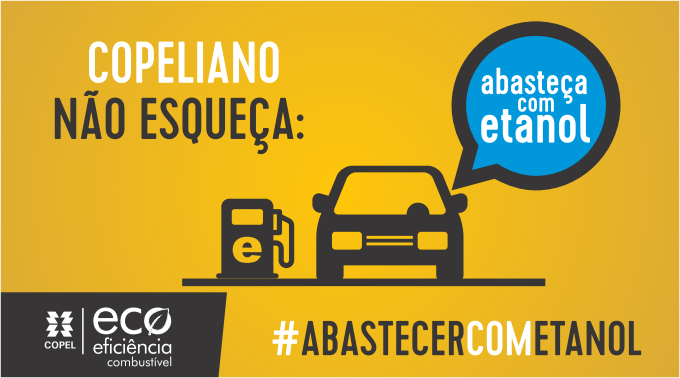
Another important milestone occurred in 2017, when Copel began prioritizing ethanol as the fuel for its entire fleet of flex-fuel vehicles, reinforcing its commitment to sustainable mobility and reducing environmental impacts.
Paper
One of the actions of the Ecoeficiência Program is directed towards the conscious use of paper and the reduction of printing, since the production processes of paper sheets and printer cartridges demand several natural resources and chemicals.
About 17% of CO2 emissions, one of the biggest contributors to climate change, are products of deforestation, and the loss of forests has a global impact on greenhouse emissions larger than the entire transportation sector.
Trees can bring solutions to some of the most dangerous problems facing the planet: pollution, species extinction, climate change, desertification, deforestation, flooding, poverty and malnutrition.
Copel has been reducing its paper consumption in recent years – a reflection of the commitment it made in 2016 to the Sustainable Development Goals. With digitization underway, there will be less and less need to print.
Education and Communication
The Education and Communication actions are the strengths of the Ecoeficiência Program, because the success of the planned initiatives depends directly on the individual actions of each employee.
Disseminating sustainable initiatives, sharing the results obtained, and facilitating this exchange of information are fundamental to promote eco-efficiency in all areas!
For this reason, we have made available the following informative materials, which can be downloaded and used in your workplace, condominium, school, etc.
Get to know them, spread the word, and do your part!
Stickers: Turn off the Light and Fuel
Air-Conditioning window sticker
But, remember: print responsibly!
Watch episodes of the Ecofficiency series
- Ecoefficiency #02 – Save and Take Care of the Environment
- Ecoefficiency #03 – Light without waste
- Ecoefficiency #04 – Save on computer usage
- Ecoefficiency #05 – Efficient use of the refrigerator
- Ecoefficiency #06 – Avoid waste with air conditioning
- Ecoefficiency #07 – Water
- Ecoefficiency #08 – Fuels
- Ecoefficiency #09 – Paper
- Ecoefficiency #10 – Waste